 By
By 
The April 30, 2026 deadline has come and gone. If you are a Starlink subscriber in Kenya and you have not yet completed your mandatory identity verification, there is a very good chance you woke up this week to no internet and an email telling you your service has been suspended. You are not alone, and the situation, while frustrating, is fixable. Here is everything you need to know about why this happened, what is going on right now, and how to get your connection back.
Why Did Starlink Require ID Verification in the First Place?
To understand the current disruptions, it helps to understand the root cause of this requirement. For most of its time in Kenya, Starlink operated in a way that was quite unusual for a telecommunications provider. You could buy a Starlink kit online, plug it in, and be online without ever showing a national ID. That era is now officially over.
The new requirement follows directives from the Communications Authority of Kenya (CA), which mandated that Starlink bring its operations in line with the country's existing telecommunications registration framework. Kenya's mobile network operators and internet service providers have long operated under strict Know Your Customer (KYC) requirements. The logic from the government's side is straightforward: if Safaricom, Airtel, Zuku, and JTL must all verify the identities of their subscribers, there is no reason a satellite internet provider should be exempt.
The legal foundation for this move is solid. Under the Kenya Information and Communications (Registration of Telecommunications Service Subscribers) Regulations, 2025, telecommunication operators and registration agents are required to collect original government-issued identification documents and verify them against existing government databases before a subscriber can access services. The regulations cover all users, including citizens, children, foreign nationals, refugees, and corporate entities.
Under revised regulations introduced by ICT Cabinet Secretary William Kabogo, the CA now requires every subscriber to an ICT service, not just SIM card holders, to be registered and authenticated against the National Integrated Population Registration System. (Techish) In short, the government wants to know who is behind every IP address in the country, and Starlink, after reportedly resisting similar directives elsewhere on the continent, chose to comply in Kenya rather than contest the requirement.
The stated reasons for the directive are also worth noting. The Kenyan government justified the mandate as a necessary tool to combat phone-based crimes and cyber-terrorism, bringing satellite operators under the same regulatory umbrella as mobile giants like Safaricom and Airtel. Beyond cybercrime, there is also an accountability angle: by linking subscriber accounts to verified national identities, regulators can ensure a level of traceability that was previously impossible with Starlink's model.
The Bigger Context: Why 2026 Is a Turning Point for Satellite Internet in Kenya
This verification deadline is not an isolated event. It is part of a much bigger shift in how Kenya is approaching satellite internet regulation. The CA has hiked satellite operator licence fees by up to 28 times, Amazon's Leo (formerly Project Kuiper) has just applied for its own Kenyan licence, and Safaricom's parent group has signed deals with both Starlink and Amazon to use satellite for rural backhaul.
The story underneath all of this is that satellite internet, once marketed and perceived as a technology that could operate outside the reach of terrestrial regulators, is being firmly pulled into the same compliance framework as every other telecoms provider in the country. For users, that means the anonymous era of satellite connectivity in Kenya is permanently closed.
It is also worth noting that Kenya has a well-established history of enforcing telecom registration deadlines. In 2022 and 2023, the Communications Authority oversaw mass SIM audits, warning that non-compliant lines would be deactivated, and they were. Millions of SIM cards were deactivated during those exercises. The April 30 Starlink deadline follows the same pattern, and enforcement has proceeded exactly as expected.
What Is Happening Right Now: Suspensions Are Real and Widespread
As of May 3, 2026, the situation on the ground is clear. Starlink has started suspending Kenyan users who failed to adhere to the mandatory registration directive for identity verification. Affected customers have started receiving suspension notices following the closure of the registration window. The suspension message being sent to affected users reads: "As required by local authorities, your Starlink service for ACC XXX-XXX has been suspended until required information has been submitted and verified."
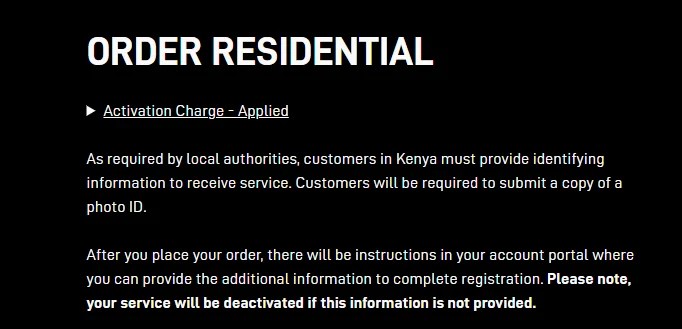
Currently, Starlink is estimated to have around 22,000 subscribers in Kenya, all of whom were expected to comply with the directive. Not everyone managed to complete the process before the deadline, and those users are now offline. According to Starlink, the interruption is linked to regulatory compliance rather than billing issues or technical faults, and suspension of accounts will remain in place until users complete the required verification process.
For those affected, particularly businesses, schools, NGOs, and households in remote or rural areas that rely on Starlink as their primary or only source of internet, the disruption is significant. Starlink's customer base in Kenya includes remote businesses, schools, NGOs, and households that rely on it as primary connectivity, and for them, interruption is not a minor inconvenience.
There is, however, reassuring news: the suspension is not permanent. To restore their services, suspended Kenyan Starlink users will need to complete their verification process at any authorised retailer in Kenya. Once verified, service is restored after confirmation.
Step-by-Step: What to Do If Your Starlink Service Has Been Suspended
If you have received a suspension notice or your Starlink dish is no longer connecting, here is exactly what you need to do to get back online. It is a two-step process, and it is important to understand that completing just one step is not enough.
Step 1: Update Your Account Online First
Log into your Starlink account on the app or at starlink.com. Look for a red banner at the top of your home page. Update your name, date of birth, gender, postal address, and phone number, and upload a photo of your government-issued ID and a passport-sized photo. Make sure the name on your account matches your ID exactly, letter for letter. Mismatches are one of the fastest ways to have your verification rejected.
This online step is where many people have been getting stuck. A name on an account that does not perfectly match a national ID, even a minor spelling difference, will cause the verification to fail. Take time to double-check this before submitting.
Step 2: Visit an Authorised Retailer in Person
Take your original ID (not a copy) and a phone with the Starlink app installed to an authorised Starlink retailer in Kenya. The retailer confirms your documents in person and ties your account to a verified physical identity. You do not need to bring your dish or router.
You can find your nearest authorised retailer through the Starlink app or by visiting starlink.com/ke. This in-person step is not optional. Anyone advising you that completing the app update alone is sufficient is giving you incomplete information.
How Long Will Restoration Take?
Once submitted, your information will need to be verified. This process may take up to a day. If incorrect information is uploaded, there may be a further delay in the verification process. Given the predictable last-minute rush that occurred around the April 30 deadline, there may currently be queues at authorised retailers and a backlog in verifications. Patience will be required, but the process is reversible.
What Documents Do You Need?
To complete the verification, you will need:
A valid, original government-issued photo identification document, which can be your Kenyan National ID card or a valid passport. The document must not be expired or damaged. You do not need to bring your Starlink hardware. You only need your phone with the Starlink app installed and logged into your account. Ensure your phone's battery is charged before heading out.
The service providers insisted that the name entered in the "Contact Information" section of the account must exactly match the details on the ID provided. This is the single most common reason verifications are delayed or rejected, so treat it as the most important detail in the entire process.
What About Privacy and Surveillance Concerns?
Not everyone has accepted this development quietly. Digital rights groups have raised concerns about state surveillance, particularly given Kenya's history of internet restrictions during periods of political tension. The government's position is that this is about cybercrime prevention and bringing all ICT services under a single, accountable regime.
These concerns are legitimate and deserve honest acknowledgment. One of Starlink's original selling points in markets like Kenya was precisely that it operated outside the traditional terrestrial infrastructure, offering a layer of connectivity resilience. Tying Starlink accounts to verified physical identities within the country may make regulatory enforcement, including targeted suspensions, easier if required under law.
There is also a surveillance dimension that is worth thinking about carefully. Under revised regulations introduced by ICT Cabinet Secretary William Kabogo, the CA now requires every subscriber to an ICT service to be registered and authenticated against the National Integrated Population Registration System. This means your internet subscription is now linked to the same national identity database used across government services. Reasonable people can disagree on whether that balance between security and privacy is the right one. But the regulatory reality is what it is, and the practical choice currently facing every Kenyan Starlink user is binary: verify, or remain offline.
A Note for Rural and Underserved Users
The impact of this deadline is felt most sharply by users outside major urban centres. Starlink became popular in Kenya precisely because it reaches areas where fibre and mobile broadband are unreliable or nonexistent. For a school in Turkana or a farming business in Laikipia, Starlink is not a backup connection; it is the only connection.
For these users, the in-person verification requirement creates an additional burden. Visiting an authorised retailer may require traveling to the nearest town, which takes time and money. If you are in this situation, it is worth calling ahead to your nearest retailer to confirm hours and availability before making the trip, and to ask whether there are any mobile verification agents operating in your region.
Looking Ahead: What This Means for Starlink in Kenya Going Forward
The enforcement of this deadline signals a permanent shift in Starlink's operational status in Kenya. The satellite provider is no longer a loosely regulated, globally managed service operating at the edges of domestic telecoms policy. It is now a fully domestically regulated provider, subject to the same oversight framework as Safaricom and Airtel.
Whether that is a good or bad thing depends on your perspective. For regulators and law enforcement, it closes a gap that existed in Kenya's digital identity infrastructure. For privacy advocates and users who valued Starlink's independence, it is a loss of that distinction. For most everyday subscribers, the honest answer is that it will make very little practical difference to the quality or cost of service once the current suspension wave passes.
What it does mean, going forward, is that any future government directive affecting internet services in Kenya will apply to Starlink users in the same way it applies to everyone else. That is a significant change from the service's original character, and it is one that all subscribers should understand clearly as they renew their subscriptions.
What You Need to Know Right Now
If your Starlink service is currently suspended, it is because of the mandatory ID verification deadline that passed on April 30, 2026. The suspension is not permanent. To restore your service, first update your account details online at starlink.com or through the Starlink app, making absolutely sure your name matches your government ID exactly. Then visit an authorised Starlink retailer in person with your original ID and a phone that has the Starlink app installed. Service is restored after your verification is confirmed, which can take up to one business day.
If you have already completed both steps and are still waiting for restoration, the process may simply be in a queue due to the high volume of late completions. Continue to monitor your account for a confirmation notification.
Comments