 By
By 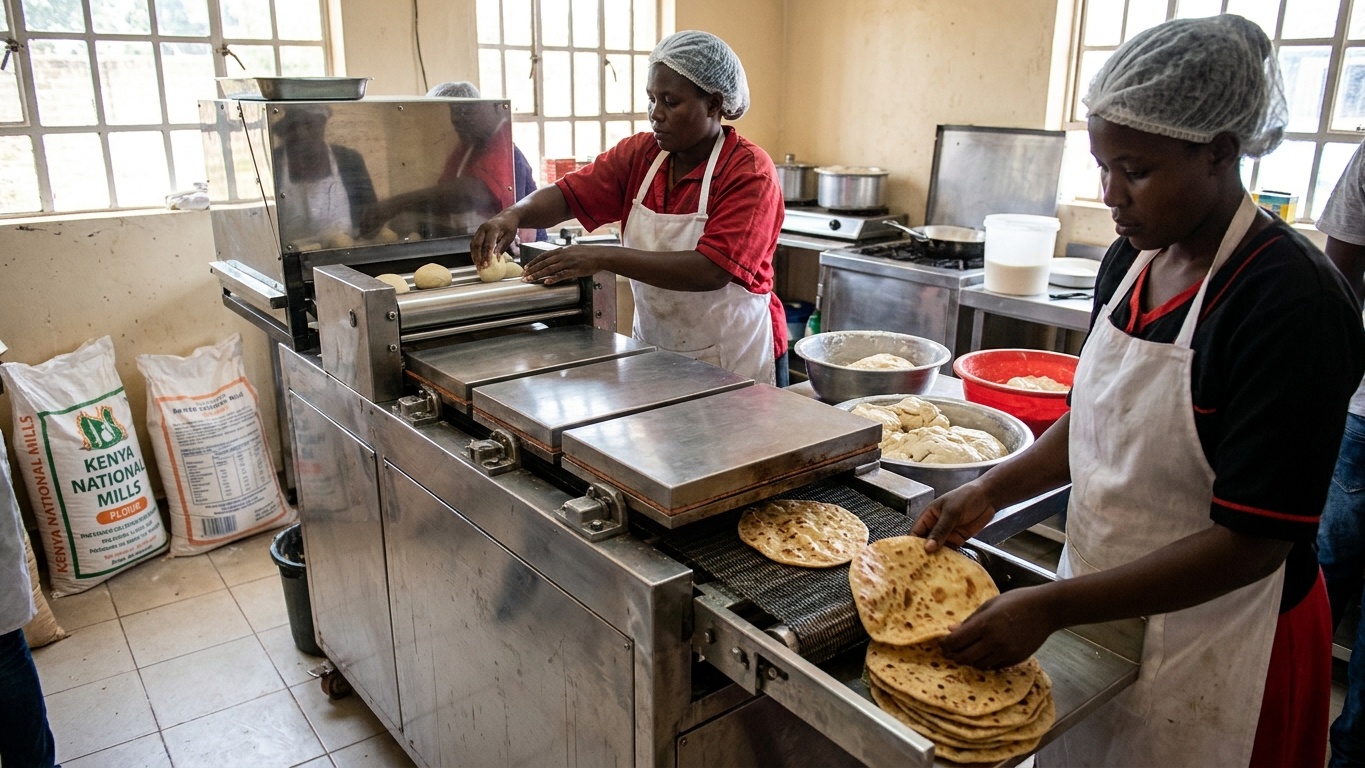
Nairobi Governor Johnson Sakaja unveiled a chapati-making machine at Toi Primary Kitchen in Kibra this week, more than a year after President William Ruto first pledged to fund one for the Dishi na County school feeding programme. Sakaja said the machine can produce up to 2,000 chapatis per hour and will now be used to add chapati to the rotation of meals served under the programme, which currently reaches more than 324,000 learners across 230 public schools in Nairobi's 17 sub-counties.
On paper, this is a small, procedural update: a piece of kitchen equipment arrived, and a subsidised school feeding programme got a new menu item. Having watched several videos of the machine in operation, tested some assumptions about how chapati-making equipment like this actually works, and traced the number back through what officials have said over the past 18 months, I think there is a more interesting gap between political promises and delivered infrastructure, and about what "good enough" actually means at public feeding scale.
From a Million a Day to 2,000 an Hour
The origin of this story goes back to March 2025, when Ruto visited Mathare on a development tour and was asked by Sakaja to help fund a chapati-making machine for Dishi na County. Ruto's response, delivered on camera, was that he would provide a machine capable of making "a million chapatis" a day. The pledge went viral almost immediately, not for its ambition but for how disconnected it seemed from any known chapati-manufacturing technology. Kenyans online nicknamed Ruto "El Chapo" and produced memes depicting industrial chapati factories. Some legislators, including Nairobi Senator Edwin Sifuna's colleague Babu Owino, argued publicly that the county had more pressing problems than automating flatbread production.
By October 2025, reality had scaled the promise down considerably. Sakaja announced that the county had gone ahead and purchased a machine, but that its actual output was 6,000 to 8,000 chapatis per hour, not a million a day. Even that figure, if run for a five-hour production window from roughly 6am to 11am as officials described at the time, would yield 30,000 to 40,000 chapatis daily, well short of the million-a-day target but still a meaningful number against a programme serving over 300,000 learners.
What actually landed at Toi Primary Kitchen this week produces up to 2,000 chapatis an hour, a figure lower than the 6,000 to 8,000 range Sakaja himself cited less than a year earlier. Whether this reflects a different machine altogether, a more conservative real-world output rating than the earlier estimate, or simply a correction once the equipment was tested under actual kitchen conditions is not something the county has explained publicly. What is verifiable is the trajectory: a promise of a million chapatis a day compressed first to 6,000 to 8,000 an hour, and now to 2,000 an hour once equipment was actually installed and switched on.
What 2,000 an Hour Looks Like at Scale
Run for the same five-hour production window officials referenced last year, a 2,000-an-hour machine yields roughly 10,000 chapatis a day. Against a programme feeding more than 324,000 learners, that is enough to serve a little over 3 percent of enrolled pupils on any given day. This is precisely why Sakaja announced a rotating schedule rather than daily chapati service: each of the 230 participating schools will be assigned its own "chapati day" rather than receiving chapati as a standing menu item. The math forces that design choice. It is not a flexible feature of the programme; it is the only way a machine of this output can touch the full learner population within a school term.
This is worth sitting with, because it reframes what the machine is actually for. It is not a replacement for the labour of chapati-making at Dishi na County's scale, nor is it capable of making chapati a routine part of the menu across the whole programme. It functions instead as a periodic supplement, most useful as a way of adding variety to specific schools on specific days, layered onto a feeding programme whose bulk of daily meals still come from other menu items and, presumably, other preparation methods.
The Manual Labour Problem, and the Quality Trade-off
Video footage of the machine in operation, some of it circulated publicly since the unveiling, shows a process that is only partially automated. Dough preparation and portioning still involve significant manual handling before the machine takes over the pressing and cooking stages. The chapatis that come out are recognisably chapati, but not uniform: shapes are irregular rather than round, and some pieces show visible holes or thin patches, the kind of inconsistency that would be considered a defect in a commercial bakery setting but is largely cosmetic in a school feeding context.
This is not a surprising outcome. Chapati has historically resisted full automation better than bread or flatbreads with more forgiving dough tolerances, precisely because the layering and rolling technique that gives chapati its texture is difficult to replicate mechanically without either sacrificing texture or requiring far more expensive, precision equipment than a county feeding programme is likely to procure. Machines that produce genuinely uniform, restaurant-quality chapati at high volume exist, but they tend to be designed for large-scale commercial food manufacturing, operate at costs well beyond what a subsidised Sh5-per-meal programme could justify, and are typically rated in chapatis per minute rather than per hour, a different order of throughput entirely.
Set against that context, a machine producing serviceable, if imperfect, chapati at 2,000 an hour is a reasonable outcome for the budget and use case, even if it falls well short of both Ruto's original pledge and Sakaja's own October 2025 estimate. For a feeding programme built around the Sh5 subsidised meal and the goal of keeping children fed and in class, uniformity and shape are not the metrics that matter. Nutrition, consistency of supply, and the ability to reach the target number of schools on schedule are the metrics that determine whether the machine is doing its job.
The Credibility Question That Remains
None of this resolves the more basic accountability question the "El Chapo" saga raised in the first place: whether officials should make large, specific, quantified promises before the underlying procurement and equipment testing has actually happened. The pattern here, a headline figure announced publicly, then revised down substantially not once but twice as procurement and installation proceeded, is not unique to this programme, but it is a useful data point for how Dishi na County's other public commitments should be read going forward.
Sakaja has framed the machine's arrival as evidence that the county "keeps its word," pointing to the broader trajectory of Dishi na County, which has expanded from serving roughly 316,000 learners in March 2025 to more than 324,000 today, and which the county says is approaching its 100 millionth served meal this term. Those figures, if verified against county records, represent real programme growth independent of the chapati machine specifically. But conflating overall programme durability with the specific, quantified pledge that generated the "El Chapo" mockery in the first place elides the fact that the number Kenyans were promised and the number that was ultimately delivered are not close, even accounting for the scaling-down that had already happened by October 2025.
The chapati machine works. It produces food that nourishes children, even if it does not look particularly polished doing it, and it slots into a feeding programme that has, by most available metrics, continued to grow. Whether that is enough to settle the credibility question the original promise raised is a separate matter from whether the machine itself is useful, and it is the question likely to resurface the next time a Kenyan official reaches for a big, round, unverified number in front of a camera.
Comments